Showing posts with label Melissa. Show all posts

Friday, February 24, 2017

March 2017: The Smell of Other People's Houses by Bonnie-Sue Hitchcock

March Book Meeting
March 9th 2017
7:30 pm with discussion starting at 8pm
Melissa's House

Discussion Questions:

1. Did you enjoy the book? why or why not?

2. Does a particular smell remind you of a certain place? a certain time? or person? Do we often connect smells and memories?

3. Alyce compares the Tongass rain forest along the coast where she and her father fish to the skinny black spruce forest that defines her home in Fairbanks. She says, "Same state, two climates, each as different as my parents; and like my parents, there's a part of me in both" (page 52). As you think about the adults in your life, what elements of them do you see in yourself? How did they become a part of your identity? Do you welcome these traits?

4. When talking to the older woman who sees Sam jump overboard from the ferry, Hank describes the scene as follows: "I am inches from her face. She says nothing and I grab her by the shoulders, gently shaking her into focus. It's like holding onto a cobweb" (page 67). Think a bit more about this simile. Why do you think the author chooses this image to describe the woman? What alternate comparison might you make?

5. What is the significance of the red strip of fabric that Dumpling wears in her hair? Where did it come from? Why does she wear it? Where does it go? Why might the author have chosen to use this particular symbol as a thread that runs through the novel?

6. Consider how Selma and Dora might work as oppositional characters in the story. How would you describe Selma's outlook on the world? How about Dora's? Do their perspectives shift over the course of the novel? Which of these two characters do you think might be the better friend for you?

7. The novel is inhabited by characters with secrets who live in a community that expects members to keep their private business private. Select one character who is silenced as a result of this expectation. How is he or she affected by the insular nature of this place? How does this norm affect the larger community, particularly given the fact that many know the truth anyway?

8. When Ruth tells her grandmother that she named the baby after her in hopes of having a sort of "do-over," her grandmother claims, "I don't deserve that"(page 222). Do you agree? Why or why not? Do you agree with Ruth's decision?

9.Characters in this novel regularly define themselves and others by their socio-economic
status—by the kind of boots they can afford, the kinds of homes in which they live,
the foods they serve at the dinner table, etc. How does money (or a lack thereof ) play
a role in the development of the characters in the novel and influence the strengths
they possess and the struggles they face? Does money matter?

10.Think about the organizational structure of the novel. Why might the author have
decided that our introduction to the story should begin with a prologue written from
Ruth’s point of view (rather than that of a different character)? Why might the author
have presented the seasonal sections (Spring, Summer, Fall, and Winter) in the order
she does? What connections can you draw, or what disconnects can you see, between
how you conceive of each season and the events that take place within it?

11. Would you recommend this book? Why or why not?
Menu:
Alaskan appetizer
Fish dish
Tuna Casserole
Chicken dumplings
Dessert: Apple Pie
              Blueberry Pie
              Canned Peaches (with ice-cream if desired:)
Melissa will provide you with drinks!

Monday, March 28, 2016

April 2016: The Phantom Tollbooth by Norton Juster

Date: March 31st 2016
Time: 7:30 discussion begins at 8
Where: Melissa's House 


1. Did you enjoy the book? Why or Why not?
2. How does language reveal a person’s character? Do you think it is fair to judge someone by his or her speech and use of language? What criteria might be used instead?
3. Which is more important words or numbers? Why?
4. Why does the authors elect names such as “Expectations” for the destinations on the map provided with the tollbooth? What might be some similar but different names for other possible places Milo might travel?
5. Who are the colorful characters Milo meets, and who was your favourite one?Why does the absence of Rhyme and Reason help to make the characters more entertaining?
6. Some of the crimes seem very silly, such as “barking without a license”. What do you think the author is trying to say by having such crimes?
7. Why should Dictionopolis, a land of words and language, be located in the Foothills of
Confusion?
8. Although most of the Humbug’s other statements are false, do you think there is any
truth to his pronouncement that “History is full of Humbugs”?
9. Do you think there are equal hazards in using too few or too many words? Which
might be more dangerous?
10. Tell about the cities of Illusion and Reality. What are the people Like? Are real people in real cities similar to the residents of these two cities in the book? Why or
why not?

11. Do you agree with the Soundkeeper that you need unpleasant sounds in order to
appreciate pleasant sounds? Might it be necessary to always have contrasts in order
to appreciate anything in the world?
12.The Dodecahedron says, “…as long as the answer is right, who cares if the question is
wrong?” Which do you think is more important, the question or the answer?
13.. What would happen if you could only eat when you were full, and only sleep when
you were a wake? What other things like that can you think of that would cause
similar problems?
14. The Phantom Tollbooth is considered a modern classic. What qualities determine a classic? Which of these qualities can you see in this book? What other books have you read that you consider classics?

15.. Contrast the first and last sentences in the book. State in your  own words the most

important lesson this book teaches.

16. Although this is considered a children’s book, many people say it is written just as much for the enjoyment of adults. What do you think? Why is it grouped with books for children?  Should it be?
17. Would you recommend this book and/or read it to your children?

MENU:
Be creative bring what you like just make sure you comment what your bringing so we don't end up with doubles.
Alphabet Soup: Sherrie
Drinks: Melissa

for some fun mixed-up treats, search for April Fools Day recipes :-)


Thursday, September 10, 2015

1984 by George Orwell

Meeting Details:
When: Thursday September 24th
Time: 7:30 Discussion begins at 8
Where: 106 Fraser Street Caledonia (Melissa's House)

 Discussion Questions
1. Did you enjoy the book? why or why not?
2. The world within which Winston lives is replete with contradictions. For example a, major tenet of the Party's philosophy is that War is Peace. Similarly, the Ministry of Love serves as, what we would consider, a department of war. What role do these contradictions serve on a grand scale? Discuss other contradictions inherent in the Party's philosophy. What role does contradiction serve within the framework of Doublethink? How does Doublethink satisfy the needs of The Party?
3. In the afterword, the commentator describes 1984 as "a warning." Indeed, throughout the text, Orwell plants both subtle and overt warnings to the reader. What do you think are some of the larger issues at hand here?
4. Describe the role that O'Brien plays in Winston's life. Why do you think that initially, Winston is drawn to O'Brien? Why does he implicitly trust him, despite the enormous dangers involved?
5. Discuss the significance and nature of Winston's dreams. Deconstruct the dream wherein O'Brien claims that they "shall meet in a place where there is no darkness" (page 22), and the dream in which Winston's mother and sister disappear (page 26). What are the underpinnings of these dreams? What deeper meanings do they hold? Why do you think the author devotes as much time as he does to Winston's dreams?
6. Discuss Winston as a heroic figure. What qualities does he posses that could define him as one?
7. On pages 147-148, Winston reflects on the omnipresence of The Party: "He thought of the telescreen with its never-sleeping ear. They could spy upon you night and day, but if you kept your head you could still outwit them….Facts at any rate, could not be kept hidden. They could be tracked down by inquiry, they could be squeezed out of you by torture. But if the object was not to stay alive, but to stay human, what difference did it ultimately make?" What, in essence, is Winston saying about the lone individual in relation to The State? Does this contention remain true throughout the novel?
8. Early on in the novel, we learn of Winston's belief in the proles as a liberating force. What accounts for Winston's almost blind faith in the proles? What are some of the characteristics of the proles that, in Winston's eyes, make them the ultimate means for overthrowing Big Brother?
9. From her first appearance as "the dark-haired girl," through to the end of the novel, Julia is a key figure in 1984. Trace the path of Julia in relation to Winston's life; in what ways does she influence him? Did you trust her, initially? Overall, do you feel she had a positive or negative impact upon him?
10. After his first formal meeting with O'Brien, Winston receives a book, ostensibly written by Emmanuel Goldberg. In reading passages from this book, Winston is further enlightened as to "how" the current society came into being. Focus on these passages, and in particular, on the theory of the High, Middle and Low classes (page 179). If true, what does this theory hold for the proles? Is Winston's plan for the proles now altered? Why or why not?
11. During Winston's interrogation, O'Brien explains that whereas preceding totalitarian regimes had failed, The Party was truly successful in its consolidation of power (page 226). How, according to O'Brien, does the The Party as an oligarchy differ from Nazism or Russian Communism? How does he define the role of the martyr, both in terms of The Party and the other totalitarian systems?
12. Following his capture in Mr. Charrington's spare room, Winston undergoes a process of "philosophical cleansing" and re-education against which he valiantly, but unsuccessfully fights. Discuss Winston's "capitulation" at the hands of O'Brien. How is Winston brought to "love Big Brother?" In sacrificing Julia, how has Winston, in essence, signaled his own end?
13. In the final analysis, how accurate was Orwell in his vision of the future? In what ways does our contemporary society compare to his idea of society in 1984? Are there examples in which he was correct? What is most opposite? Do you see a potential for aspects of Orwell's "vision" to come true?
14. During his final encounter with O'Brien, Winston argues that, if all else fails, the inherent nature of the individual—the "spirit of man"—is strong enough to undermine a society such as that created by The Party. Do you agree or disagree with this statement? Is Winston's belief applicable to the world we live in today? Can you cite examples in our own recent history that support or dismiss Winston's belief in the resiliency and righteousness of the human spirit?
15. Prior to meeting her, Winston fantasizes about Julia in violent, humiliating ways. Later, he describes in his diary an encounter with a middle-aged, toothless prostitute. How do you account for these thoughts? How does Winston's understanding of women change after his first liaison with Julia?
16. Given Winston's own acknowledgment that he is under constant surveillance, and that it would only be a matter of time before the Thought Police caught him, no one in his world could be trusted. Prior to his capture, which character or characters did you envision as betraying Winston? How did you foresee his ultimate demise? Did you, on the contrary, feel that by some chance he would overcome the forces aligned against him, and fulfill his wish to conquer The Party?
17. Imagine yourself as Winston Smith at the beginning of 1984. What would you do to undermine The Party? Knowing what you know now, how would you extricate yourself from the fate that awaits you?
18. Refer back to Winston's conversation with the old man at the pub (page 78). Why is Winston so determined in his approach to the old man? What is Winston hoping to learn from him?
19. Would you recommend this book? why or why not?

MENU
In Winston's time there is a lack of food. Bring a food you would really crave/miss if you couldn't have it again. Please respond with what you are bringing so we don't have the same items.

Monday, March 30, 2015

Great Cookbooks!!

 I love reading. I love to cook and bake. I love to eat. So to me there is nothing better than a cookbook with a story, great recipes, and pictures that make my mouth water. These are two of my favourites right now! Give me a cup of coffee, a delectable treat and one of these cookbooks, I am set for a good couple of hours. Food for me is a passion and also an entrance into places over the world that at the moment I can only afford to take my taste buds too.


Brown eggs and Jam Jars has been an inspiration to me. I love the way Aimee helps you realize you do not need to have a big country lot to enjoy growing your own vegetables or fruit. She seems like a down to earth woman I could sit and chat with. I have tried some of recipes which are simple but so yummy.
Aimée’s rural-homesteader upbringing, years working as a professional chef, and everyday life as a busy mom led to the creation of the hugely popular blog Simple Bites. Raising three young children with husband Danny, Aimée traded her tongs and chef whites for a laptop and camera, married her two passions—mothering and cooking—and has since been creating recipes with an emphasis on whole foods for the family table, sharing stories and tips, and inspiring readers to make the family–food connection on the Simple Bites blog.
Brown Eggs and Jam Jars is Aimée’s long-awaited cookbook, inspired by her urban homesteading through the seasons and the joyous events they bring. It embraces year-round simple food with fresh flavours, from celebrating spring with a stack of Buttermilk Buckwheat Pancakes and pure maple syrup, to a simple late-summer harvest dinner with Chili-Basil Corn on the Cob and Lemon Oregano Roast Chicken. Autumn favourites include Apple Cinnamon Layer Cake with Apple Butter Cream Cheese Frosting, while Slow Cooker Cider Ham is the perfect comfort food for those cold winter nights. But that’s just a few of the more than one hundred recipes (like melt-on-your-tongue maple butter tarts and tangy homemade yogurt) that have a touch of nostalgia, feature natural ingredients, and boast plenty of love.
Brown Eggs and Jam Jars will inspire readers to connect family and food right where they are in life—from growing their own tomatoes to making a batch of homemade cookies. Enjoy your urban homestead.   (From Good reads)
 I will enjoy this cookbook for years to come!


 This cookbook is beautiful, I think I sigh many "oohs and ahhs" every time I open it! France has always been on my list of dream travel destinations (probably mostly due to food!!). I am already planning many fancy adult only dinner parties with this cookbook! Anyone want to come for dinner? Cant be a picky eater;).
When Mimi Thorisson and her family moved from Paris to a small town in out-of-the-way Médoc, she did not quite know what was in store for them. She found wonderful ingredients—from local farmers and the neighboring woods—and, most important, time to cook. Her cookbook chronicles the family’s seasonal meals and life in an old farmhouse, all photographed by her husband, Oddur. Mimi’s convivial recipes—such as Roast Chicken with Herbs and Crème Fraîche, Cèpe and Parsley Tartlets, Winter Vegetable Cocotte, Apple Tart with Orange Flower Water, and Salted Butter Crème Caramel—will bring the warmth of rural France into your home. (From Goodreads).
Do you have a favourite cookbook? Would love to hear about it:)


Monday, November 17, 2014

Slave by Mende Nazer

Mende Nazer lost her childhood at age twelve, when she was sold into slavery. It all began one horrific night in 1993, when Arab raiders swept through her Nuba village, murdering the adults and rounding up thirty-one children, including Mende.

Mende was sold to a wealthy Arab family who lived in Sudan's capital city, Khartoum. So began her dark years of enslavement. Her Arab owners called her "Yebit," or "black slave." She called them "master." She was subjected to appalling physical, sexual, and mental abuse. She slept in a shed and ate the family leftovers like a dog. She had no rights, no freedom, and no life of her own.

Normally, Mende's story never would have come to light. But seven years after she was seized and sold into slavery, she was sent to work for another master—a diplomat working in the United Kingdom. In London, she managed to make contact with other Sudanese, who took pity on her. In September 2000, she made a dramatic break for freedom.

Slave is a story almost beyond belief. It depicts the strength and dignity of the Nuba tribe. It recounts the savage way in which the Nuba and their ancient culture are being destroyed by a secret modern-day trade in slaves. Most of all, it is a remarkable testimony to one young woman's unbreakable spirit and tremendous courage.

I could not put this book down! It is hard to believe this happened not too long ago and probably still continues to take place! Reminded me of the book "A long way Gone" about the boy soldier. There is also a second book she has written called "Freedom", I have not read this one but will be soon!! A great read!

Saturday, June 21, 2014

July 2014: In a Sunburned Country by Bill Bryson

 Meeting Details:
Where: Melissa's House (106 Fraser Street Caledonia Ontario)
When: Thursday July 3rd 2014
Time: 7:30pm with the discussion beginning at 8pm
**Will send out a reminder email 1 week before the meeting.

Discussion Questions:
1. Did you like the book? If so, what was your favourite part of the book? If not, why?
2. Do you have any interest in traveling to Australia, or have you been there?
3. Did you like Bryson's narrative style? Have you read any of his other books, if you did how did this one compare?
4. Did Bill introduce you to an Australia that was different from your mental image of the place? What was unexpected in his account of the land and people?
5. What was your favourite geographic region in Australia? We're you surprised to find there were so many ecosystems there?
6. Did Bill succeed in describing people and places such that you could picture them in your mind? For example, could you 'see' Uluru in your mind?
7. What is Bryson's attitude toward Australia? What do you think of his attitude?
8. What do you think of Bryson's comments on the Australian Aborigines?
9. In Chapter 16, Bryson muse son the American influence in Alice Springs:
    "On our way into town, we passed strip malls, car dealerships, McDonald's and Kentucy Fried Chicken outlets, banks, and gas stations....My room had a balcony where I could watch the setting sun flood the desert floor and burnish the golden slopes of the McDonnell Ranges beyond- or at least I could if I looked past the more immediate sprawl of a Kmart plaza across the road. In the 2 million or more square miles that is the Australian outback. I don't suppose there is a more unfortunate juxtaposition.
   Allan was evidently held by a similar thought, for a half hour later when we met out front he was staring at the same scene. "I can't believe we've just driven a thousand miles to find a Kmart," he said. He looked at me. "You Yanks have a lot to answer for, you know."
   I started to protest, in a sputtering sort of way, but what could I say?. He was right. We do. We have created a philosophy of retailing that is totally without aesthetic and totally irresistible. And now we box these places up and ship them to the far corners of the world. Visually, almost every arrestingly regrettable thing in Alice Springs was a product of American enterprise...what a sad and curious age we live in.
Reactions? Comments?
10. Did you find a paradox in the laid-back style of the people of Australia, given that they live in a country with vast empty deserts, stinging plants and jellyfish, and killer sharks? Why do you suppose Australians are so famously mellow, as Bill himself confirmed?
11. Did anything that happened or was said in the book stick with you?
12. Would you recommend this book? Why or why not?

Down Under Menu
Main:
*Shrimp on the Barbie - Melissa
*sausage Rolls
*Meat Pie
Dessert:
*Pavlova
*Lammingtons

Melissa will be providing the drinks!

Wednesday, January 22, 2014

The Day the Crayons Quit by Drew Daywalt

Poor Duncan just wants to color. But when he opens his box of crayons, he finds only letters, all saying the same thing: We quit!

All his crayons have written Duncan a letter expressing their grievances and why they have quit. Beige is tired of playing second fiddle to Brown. Blue needs a break from coloring all that water, while Pink just wants to be used. Green has no complaints, but Orange and Yellow are arguing over who is the true colour of the sun and are driving the other crayons crazy!

What is Duncan to do? Debut author Drew Daywalt and New York Timesbestseller Oliver Jeffers create a colorful solution in this playful, imaginative story that will have children laughing and playing with their crayons in a whole new way.


This is one of the funniest picture books, laugh-out-loud funny, I've read in a long time. One of those books we have read lots since Christmas and I still find myself hoping the kids will pick it as one of their bedtime stories every night.

Each spread features the letter from the color and drawings by Duncan or his coloring books. I loved the variety of papers on which the crayons wrote their letters. 


There is one "goodness knows" if that bothers you;) Just had to write a review because this is one of my favourite children's picture book!!

Monday, December 30, 2013

A House In The Sky by Amanda Lindhout and sara Corbett

The dramatic and redemptive memoir of a woman whose curiosity led her to the world’s most beautiful and remote places, its most imperiled and perilous countries, and then into fifteen months of harrowing captivity—an exquisitely written story of courage, resilience, and grace.

As a child, Amanda Lindhout escaped a violent household by paging through issues of National Geographic and imagining herself in its exotic locales. At the age of nineteen, working as a cocktail waitress in Calgary, Alberta, she began saving her tips so she could travel the globe. Aspiring to understand the world and live a significant life, she backpacked through Latin America, Laos, Bangladesh, and India, and emboldened by each adventure, went on to Sudan, Syria, and Pakistan. In war-ridden Afghanistan and Iraq she carved out a fledgling career as a television reporter. And then, in August 2008, she traveled to Somalia—“the most dangerous place on earth.” On her fourth day, she was abducted by a group of masked men along a dusty road.

Held hostage for 460 days, Amanda converts to Islam as a survival tactic, receives “wife lessons” from one of her captors, and risks a daring escape. Moved between a series of abandoned houses in the desert, she survives on memory—every lush detail of the world she experienced in her life before captivity—and on strategy, fortitude, and hope. When she is most desperate, she visits a house in the sky, high above the woman kept in chains, in the dark, being tortured.

Vivid and suspenseful, as artfully written as the finest novel, A House in the Sky is the searingly intimate story of an intrepid young woman and her search for compassion in the face of unimaginable adversity. (cover)


A good part of the book is getting to know Amanda's family life and work life, you need this to see why she makes the choices she makes...some are not great!

You can see that Amanda is a compassionate person, while reading the book she makes you get a clear picture of who her captors where ( I even really liked ones character). Amanda, months after returning home, founded the Global Enrichment Foundation. Originally focusing on educational initiatives for women in Somalia, this foundation continues to create development and aid in Somalia and Kenya to this day. She is using her horrible experience for better.

I ordered Nigel Bennan's book the price of life just to see what his side looked at,( I won't get it for a couple of months but will let you know what I think when I do:) Amanda at times made him seem like he was a little wimpy. It is amazing how two people can go through a life changing event together and then not speak to each other any more once they are free! I do believe the families are at odds because of the ransom money.

A good read!! I do own this book if you want to borrow it. There is one person who has claimed it already but you can be next:)


Saturday, December 21, 2013

Longbourn by Jo Baker

If Elizabeth Bennet had the washing of her own petticoats, Sarah often thought, she’d most likely be a sight more careful with them. 
In this irresistibly imagined below stairs answer to Pride and Prejudice, the servants take center stage. Sarah, the orphaned housemaid, spends her days scrubbing the laundry, polishing the floors, and emptying the chamber pots for the Bennet household. But there is just as much romance, heartbreak, and intrigue downstairs at Longbourn as there is upstairs. When a mysterious new footman arrives, the orderly realm of the servants’ hall threatens to be completely, perhaps irrevocably, upended.

Jo Baker dares to take us beyond the drawing rooms of Jane Austen’s classic—into the often overlooked domain of the stern housekeeper and the starry-eyed kitchen maid, into the gritty daily particulars faced by the lower classes in Regency England during the Napoleonic Wars—and, in doing so, creates a vivid, fascinating, fully realized world that is wholly her own. (goodreads)
I really enjoyed this book. If you love Jane Austin's characters you will love the housemaids in the Bennet house as well. Longbourn made the Bennet home come alive. While reading this book you felt as if you lived in the same house as Miss Elizabeth, Jane, Kitty, Lydia, Mary and Mr. and Mrs. Bennet. You know what time the housemaids got up to light the fires and draw the water. You know how the housemaids scrubbed the laundry, prepared meals and went to Meryton to get supplies.
If you need a good book to read this one will not disappoint. (well...it did not disappoint me:)

Thursday, December 19, 2013

I am Malala by Malala Yousafzai and Christina Lamb

I come from a country that was created at midnight. When I almost died it was just after midday.

When the Taliban took control of the Swat Valley in Pakistan, one girl spoke out. Malala Yousafzai refused to be silenced and fought for her right to an education.

On Tuesday, October 9, 2012, when she was fifteen, she almost paid the ultimate price. She was shot in the head at point-blank range while riding the bus home from school, and few expected her to survive.

Instead, Malala's miraculous recovery has taken her on an extraordinary journey from a remote valley in northern Pakistan to the halls of the United Nations in New York. At sixteen, she has become a global symbol of peaceful protest and the youngest nominee ever for the Nobel Peace Prize.

I Am Malala is the remarkable tale of a family uprooted by global terrorism, of the fight for girls' education, of a father who, himself a school owner, championed and encouraged his daughter to write and attend school, and of brave parents who have a fierce love for their daughter in a society that prizes sons.

I Am Malala will make you believe in the power of one person's voice to inspire change in the world.(From good reads.)


"I was a girl in a land where rifles are fired in celebration of a son, while daughters are hidden away behind a curtain, their role in life simply to prepare food and give birth to children." This statement in itself is so sad. Although Malala's dad was thrilled with his baby girl.


"I was 10 when the Taliban came to our valley ... It seemed to us that the Taliban arrived in the night just like vampires. They appeared in groups, armed with knives and Kalashnikovs ... They looked so dark and dirty and that my father's friend described them as 'people deprived of baths and barbers.' Shows how the Taliban are so corrupt!

"Why are we Muslims fighting with each other? ... We should focus on practical issues. We have so many people in our country who are illiterate, and many women have no education at all. We live in a place where schools are blown up. We have no reliable electricity supply. Not a single day passes without the killing of at least one Pakistani." Malala prays one day her country will have freedom of speech, education, and religion.

I enjoyed this book it was very informative, gave a great picture of Pakistan and the lovely landscape but also hard truths of what really goes on. Malala's book has been banned in Pakistan because they claim it is disrespectful to islam. Would be an interesting book club read:)


Wednesday, October 16, 2013

Dinner: A Love Story & Mad Hungry: Feeding Men & Boys

                                                                             
                                                               MAD HUNGRY: FEEDING MEN & BOYS

When first published in 2009, Lucinda Scala Quinn''s Mad Hungry met with critical acclaim, but it wasn't just the media that fell hard for this book--it was mothers everywhere, who embraced her message to bring back the family meal and loved the ease, simplicity, and robust goodness of her recipes. The book went on to launch a TV series (Mad Hungry with Lucinda Scala Quinn) and now, with over 65,000 copies sold, it is available in a paperback edition that will reach a yet wider audience.
   In Mad Hungry, Scala Quinn shares winning strategies for how to sate the seemingly insatiable, trade food for talk, and get men to manage in the kitchen. She provides recipes for single-skillet meals, dinners that yield fabulous leftovers, and dishes that are a cinch to stretch fore extra guests. Her grab-and-run breakfasts will help kids start the day right, and her healthful drinks make it easier for guys to say no to soda. Along with her techniques that help make homemade meals second nature, nourishing both diner and cook, Scala Quinn offers empowering advice on how to feed one''s family''s spirits as well as fill their bellies.


DINNER: A LOVE STORY
Jenny Rosenstrach, and her husband, Andy, regularly, some might say pathologically, cook dinner for their family every night. Even when they work long days. Even when their kids'' schedules pull them in eighteen different directions. They are not superhuman. They are not from another planet.
With simple strategies and common sense, Jenny figured out how to break down dinner-the food, the timing, the anxiety, from prep to cleanup-so that her family could enjoy good food, time to unwind, and simply be together.
Using the same straight-up, inspiring voice that readers of her award-winning blog, Dinner: A Love Story, have come to count on, Jenny never judges and never preaches. Every meal she dishes up is a real meal, one that has been cooked and eaten and enjoyed at least a half dozen times by someone in Jenny''s house. With inspiration and game plans for any home cook at any level, Dinner: A Love Storyis as much for the novice who doesn''t know where to start as it is for the gourmand who doesn''t know how to start over when she finds herself feeding an intractable toddler or for the person who never thought about home-cooked meals until he or she became a parent. This book is, in fact, for anyone interested in learning how to make a meal to be shared with someone they love, and about how so many good, happy things happen when we do.

I love cooking and reading a good cookbook!  I thought these two looked good (and Christmas is coming up:), also thought since we talk about how much our boys can eat this second one may interest a few of us. 


Saturday, October 5, 2013

The Sweetness at the Bottom of the Pie Review

 Some of us really enjoyed this witty book and others only kept reading for the sake of book club. Flavia was an interesting 11 year old character! A few of us thought she was a little too much and not your typical 11 year old. There was nothing really sweet about Flavia she was in our opinion a little psycho. If you look at how she was brought up, no mother, a father and sisters who don't care what you do as long as your home for meals, its no wonder she is the way she is. Flavia's relationship with her father is not much of a relationship. She has a  moment with her father in the jail, Bradley writes it so well, "And so we sat, Father and I, primly, like two old women at parish tea. It was not a perfect way to live one's life, but it would have to do." That was the extent of their relationship.

 Bradley has a charming way of writing and does a great job of describing Buckshaw especially Flavia's laboratory. One reason some of us would pick up more of his books would be to visit Buckshaw estate again and to see what Flavia is up to.

 Another favorite paragraph was "It's a fact of life that a girl can tell in a flash if another girl likes her. Feely says that there is a broken telephone connection between men and women, and we can never know which of us rang off. With a boy you can never know whether he's smitten or gagging, but with a girl you can tell in the first three seconds. Between the girls there is a silent and unending flow of invisible signals, like the high-frequency wireless messages between the shore and the ships at sea, and this secret flow of dots and dashes was signaling that Mary detested me."

 Over all a light fun read with not much of a mystery.

 One question we all want to ask Mr. Bradley "Who on earth changed Flavia's diapers when she was a baby?!!"

Thursday, October 3, 2013

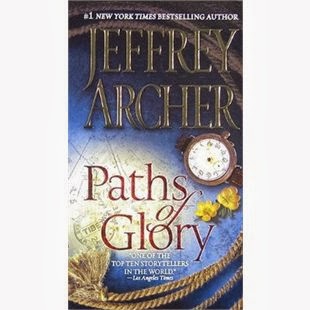
Above All Things and Paths of Glory

ABOVE ALL THINGS by Tanis Rideout
The Paris Wife meets Into Thin Air in this breathtaking novel of love and obsession, which tells the story of George Mallory's legendary attempt to be the first man to conquer Mount Everest - and of the remarkable woman he left behind to await news of his fate.

A captivating blend of historical fact and imaginative fiction,Above All Things moves seamlessly between the epic story of Mallory's final expedition and a moving account of a day in the life of his wife, Ruth. Through George's perspective, and that of the newest member of the climbing team, Sandy Irvine, we get an astonishing picture of the terrible risks taken by the men on the treacherous terrain of the Himalaya. But it is through Ruth's eyes that a complex portrait of a marriage emerges, one forged on the eve of the First World War, shadowed by its losses, and haunted by the ever-present possibility that George might not come home. Drawing on years of research, this powerful and beautifully written novel is a timeless story of desire, redemption, and the lengths we are willing to go for honor, glory, and love.


         PATHS OF GLORY by Jeffrey Archer
Some people have dreams that are so magnificent that if they were to achieve them, their place in history would be guaranteed. But what if one man had such a dream…and once he'd fulfilled it, there was no proof that he had achieved his ambition?
This is the story of such a man: George Mallory. He once told an American reporter that he wanted to climb Mt. Everest "because it's there." On his third attempt in 1924, at age thirty-seven, he was last seen six hundred feet from the top. His body was found in 1999. And it still remains a mystery whether he ever reached the summit


  Reading these two books I really fell in love with George Mallory! I believe Mallory was the first man to climb Everest:) It is always amazing to see how far someone will go to accomplish their dreams, not always a good thing.

Wednesday, September 11, 2013

October 2013- Sweetness at the Bottom of the Pie

Meeting Details:
Date: October 3rd 2013
Where: Melissa's House
            106 Fraser Street Caledonia Ont
Time: 7:30pm discussion begins at 8pm

Discussion Questions:
1. Did you enjoy the book? Why or why not?
2.With her high level of knowledge, her erudition and her self-reliance, Flavia hardly seems your typical eleven-year-old girl. Or does she? Discuss Flavia and her personality, and how her character drives this novel. Can you think of other books that have used a similar protagonist?
3.The Sweetness at the Bottom of the Pie falls within the tradition of English country house mysteries, but with the intelligent Flavia racing around Bishop’s Lacey on her bike instead of the expected older woman ferreting out the truth by chatting with her fellow villagers. Discuss how Bradley uses the traditions of the genre, and how he plays with them too.
4. What is your favorite scene from The Sweetness at the Bottom of the Pie?
5. With her excessive interest in poisons and revenge, it’s no surprise that Flavia is fascinated, not scared, as she watches the stranger die in her garden. In your view, is her dark matter-of-factness more refreshing or disturbing?
6. Flavia reminds us often about Harriet, the mother she never knew, and has many keepsakes that help her imagine what she was like. Do you think the real Harriet would have fit into Flavia’s mold?
7. Flavia’s distance from her father, the Colonel, is obvious, yet she loves him all the same. Does their relationship change over the course of the novel in a lasting way? Would Flavia want it to?
8. Through Flavia’s eyes what sort of a picture does Alan Bradley paint of the British aristocracy? Think as well about how appearances aren’t always reality, as with the borderline bankruptcy of Flavia’s father and Dr. Kissing.
9. Discuss the meaning (or meanings) of the title The Sweetness at the Bottom of the Pie.
10. What twists in the plot surprised you the most?
11. Buckshaw, the estate, is almost a character in its own right here, with its overlarge wings, hidden laboratory, and pinched front gates. Talk about how Bradley brings the setting to life in this novel—not only Buckshaw itself, but Bishop’s Lacey and the surrounding area.
12. What does Flavia care about most in life? How do the people around her compare to her chemistry lab and books?
13. Like any scientist. Flavia expects her world to obey certain rules, and seems to be thrown off kilter when surprises occur. How much does she rely on the predictability of those around her, like her father and her sisters, in order to pursue her own interests (like solving the murder)?

14. Would you recommend this book? Why or why not?

What is on the MENU
    
 Main
   Please feel free to use whatever recipe you like, switch it up a bit:)


Dessert:
  • Custard pie - Stephanie
  • Pecan pie
  • Pumpkin pie - Tessa
  • Apple pie - Amanda
*There will be a reminder email sent out a week before the meeting :) Hope you enjoy the book!

Sunday, May 5, 2013

My Antonia By Willa Cather

My Ántonia is one of eight classic American novels featured in the National Endowment for the Arts Big Read initiative, designed to restore reading to the center of American culture. The Big Read provides citizens with the opportunity to read and discuss a single book within their communities and is supported by expansive outreach and publicity campaigns. Over one hundred communities will participate in 2007, each with a program lasting approximately one month. A kick-off event is followed by panel discussions, film screenings, and lectures or public readings devoted to the book.

Willa Cather’s heartfelt novel is the unforgettable story of an immigrant woman’s life on the hardscrabble Nebraska plains. Through Jim Burden’s affectionate reminiscence of his childhood friend, the free-spirited Ántonia Shimerda, a larger, uniquely American portrait emerges, both of a community struggling with unforgiving terrain and of a woman who, amid great hardship, stands as a timeless inspiration. (From Goodreads)


I enjoyed reading this classic. I had never heard of Willa Cather before reading this book, I enjoy her style of writing and the time frame of her books. When you read about Willa she seems like a very interesting woman:)

Thursday, April 25, 2013

Six ways to keep the "Good" in your Boy and Six ways to keep the "little" in your girl by Dannah Gresh

Six Ways to Keep the "Good" in Your Boy: Guiding Your Son from His Tweens to His Teens
When bestselling author Dannah Gresh was body-slammed by her 12-year-old son, she was hit with reality: raising a boy is a whole new ballgame!
A boy's relationship with his mom during the formative age between 8 and 12 is vital to his future well-being. So how can moms teach sons to be honest, confident, and respectful when the world and situations encourage them to make bad decisions and grow up too fast?
Dannah's practical experience and research, along with advice from her husband, Bob Gresh, provide a mom with six proactive ways to help her son:
  • honor his body in a healthy way
  • get outside to play unplugged
  • live out his faith
This accessible resource will empower moms with information and hope to raise sons of integrity and faith. Includes an insightful Connection IQ Inventory test, activity ideas, and Scriptures to pray over sons.

                                                                             Six Ways to Keep the "Little" in Your Girl
                                                                                     by
Bestselling author, speaker, and founder of the Secret Keeper Girl conferences, Dannah Gresh shares with moms the secret to helping today's girls grow up confident, grace-filled, and strong in their faith.
Studies show that the foundation for an emotionally healthy teen girl is built between the ages of 8-12 and that a good relationship with mom is one of the most important factors. So when the world wants girls to grow up too fast, how does a mother help her young daughter navigate the stormy waters of boy-craziness, modesty and body image, media, Internet safety, and more? With a warm, transparent style, Dannah Gresh shares six ways a mom can help protect and guide her daughter, including:
  • help her celebrate her body in a healthy way
  • unbrand her when the world tries to buy and sell her
  • unplug her from a plugged-in world
  • dream with her about her prince, and more
This wonderful resource also provides moms a Connection IQ Inventory to test their mom- daughter relationship, creative and fun activities to do together, and Scriptures for the mom to pray for her daughter.
 
 I have these two books and have read them both at least twice already. Thought there are a lot of us with young kids in the book club that could really benefit from these books, I know I sure have! Would also make a great present for new parents (maybe from grandparents;).

Thursday, April 18, 2013

The Maze Runner by James Dashner

When Thomas wakes up in the lift, the only thing he can remember is his first name. His memory is blank. But he’s not alone. When the lift’s doors open, Thomas finds himself surrounded by kids who welcome him to the Glade—a large, open expanse surrounded by stone walls.

Just like Thomas, the Gladers don’t know why or how they got to the Glade. All they know is that every morning the stone doors to the maze that surrounds them have opened. Every night they’ve closed tight. And every thirty days a new boy has been delivered in the lift.

Thomas was expected. But the next day, a girl is sent up—the first girl to ever arrive in the Glade. And more surprising yet is the message she delivers.

Thomas might be more important than he could ever guess. If only he could unlock the dark secrets buried within his mind.

 It took a while to understand what was going on in the book, but once I started to get it, I really enjoyed this book. It reminded me of "Lord of the flies", "A brave new world" and "hunger games" twisted together. I am looking forward to reading the next two in this trilogy.

Tuesday, February 12, 2013

The Unlikely Pilgrimage of Harold Fry

Harold Fry is convinced that he must deliver a letter to an old love in order to save her, meeting various characters along the way and reminiscing about the events of his past and people he has known, as he tries to find peace and acceptance.

Recently retired, sweet, emotionally numb Harold Fry is jolted out of his passivity by a letter from Queenie Hennessy, an old friend, who he hasn't heard from in twenty years. She has written to say she is in hospice and wanted to say goodbye. Leaving his tense, bitter wife Maureen to her chores, Harold intends a quick walk to the corner mailbox to post his reply but instead, inspired by a chance encounter, he becomes convinced he must deliver his message in person to Queenie--who is 600 miles away--because as long as he keeps walking, Harold believes that Queenie will not die.

So without hiking boots, rain gear, map or cell phone, one of the most endearing characters in current fiction begins his unlikely pilgrimage across the English countryside. Along the way, strangers stir up memories--flashbacks, often painful, from when his marriage was filled with promise and then not, of his inadequacy as a father, and of his shortcomings as a husband.

Ironically, his wife Maureen, shocked by her husband's sudden absence, begins to long for his presence. Is it possible for Harold and Maureen to bridge the distance between them? And will Queenie be alive to see Harold arrive at her door?


Loved this line: "They had looked at him in his yachting shoes, and listened to what he said, and they had made a decision in their hearts and minds to ignore the evidence and to imagine something bigger and something infinitely more beautiful than the obvious."

I enjoyed this book:)

Wednesday, February 6, 2013

Ru by Kim Thuy

At ten years old, Kim Thúy fled Vietnam on a boat with her family, leaving behind a grand house and the many less tangible riches of their home country: the ponds of lotus blossoms, the songs of soup-vendors. The family arrived in Quebec, where they found clothes at the flea market, and mattresses with actual fleas. Kim learned French and English, and as she grew older, seized what opportunities an immigrant could; she put herself through school picking vegetables and sewing clothes, worked as a lawyer and interpreter, and later as a restaurateur. She was married and a mother when the urge to write struck her, and she found herself scribbling words at every opportunity - pulling out her notebook at stoplights and missing the change to green. The story emerging was one of a Vietnamese émigré on a boat to an unknown future: her own story fictionalized and crafted into a stunning novel. The novel's title, Ru, has meaning in both Kim's native and adoptive languages: in Vietnamese, ru is a lullaby; in French, a stream. And it provides the perfect name for this slim yet potent novel. With prose that soothes and sings, Ru weaves through time, flows and transports: a river of sensuous memories gathering power. It's a classic immigrant story told in a breathtaking new way. From Good reads.

Reflections of a woman who fled Vietnam as a child and settled in Canada. Beautifully written! Was originally written in French translated by Sheila Fischman. I really enjoyed this book:)

Saturday, January 26, 2013

Home From The Vinyl Cafe: A Year Of Stories by Stuart McLean

Welcome to the world of the Vinyl Cafe. Meet Dave, the proud owner of the world's smallest record store. Meet his pal, Kenny Wong, who runs Wong's Scottish Meat Pies. Meet Dave's wife and their children. Watch while they all bump and stumble through a hilarious year of mistakes, miscues, misunderstandings, and muddle.
The adventures begin in December with Dave's disastrous yet inspired attempts to cook the family turkey. And they move through the seasons to the following Christmas's fiasco, when Dave accidentally spikes the kids' punch bowl at his neighbor's Christmas soiree.
Home from the Vinyl Cafe also explores the tender awkwardness of first love, the challenges presented by a dying guinea pig, and the answer to the question of why a teenager would rather eat vegetables and clean his room than go on a family vacation.
Whether it's the mystery of sending kids to camp, the dangers of putting up Christmas lights, or the potential for mayhem at the grocery store, in the hands of humorist and master storyteller Stuart McLean the chaotic melody of daily life is underscored by the harmonious sounds of family, friends, and neighbors.
Warm, witty, and moving, these stories will walk right into your life and make themselves at home.

 I think this would be a great short stories book to do one month! I really enjoy reading and listening to Stuart McLean!