Showing posts with label Tessa. Show all posts

Saturday, May 2, 2020

Virtual Book Club for May/June 2020

Fifteen Dogs cover artAnyone interested in a virtual book club?  

Here's what I'm thinking: 

  1. Listen to this FREE audiobook at your own pace (its 6 hrs 20 min long) anytime in May or June. 
  2. Answer Questions - pop on over to the blog and answer some/all/any of the questions by editing the post and adding your thoughts right here (not in the comments, where it may be hard to follow the train of thought for any particular question).  Feel free to pick&choose from the questions, based on your thoughts/interests.  Absolutely no need to answer ALL of the questions in order to participate.  Include your initials by your answer so we know it's you.
  3. Reply to some/all/any responses, if you like - check back here to see what others thought.  Add a reply directly in the post, adding your initials again.  

Here's the FREE audio book (available until June 28th)
https://www.audible.ca/pd/Fifteen-Dogs-Audiobook/B071RXCKWQ?ref=a_ep_listen_c6_lProduct_1_2&pf_rd_p=362b9add-c610-448a-acc1-59556414c4f7&pf_rd_r=N47JH4AYKKTBFSDPNDZV

Discussion Questions: 

1. Did you enjoy the book?  Why or why not?

2. What did you think of the audio version of the book?  What did you like/dislike about the way it was read?  If you haven't listened to an audio book before, would you do it again?


3. Which dog are you most drawn to? Least? Why?

4. Can you imagine how the story might have been different if Alexis had chosen cats? What about elephants or mosquitoes? 

5. Hermes and Apollo’s wager is decided by whether or not one of the dogs is happy at the moment of its death. Is it fair to evaluate the quality of one’s life by the quality of one’s end-of-life? How accurate of an evaluation is this in the case of the dogs? 

6. Prince’s poetry delights some of the dogs and enrages others. He is arguably the most isolated of the original pack. Is Alexis suggesting that art is essentially divisive? Or is Prince’s place in the pack a reflection of the nature of being an artist? 

7. Who is more cruel, the gods or the dogs? Why? 

8. Does the version of humanity Alexis presents reflect your own? In what ways do they differ? 

9. Some readers find themselves more moved by the deaths of the fifteen dogs than they would have been if it had been fifteen humans. Why do we sometimes have more compassion for animals than people? Can you think of examples of this in the real world? 


10. True to canine nature, Atticus’s pack is ruled by brute power and a clear sense of hierarchy. But Hermes and Apollo’s wager is about happiness, not power. What is the relationship between power and happiness for the dogs? Is there a clear correlation?
 
11. If you are familiar with Toronto, did the book allow you to think about the city’s landscape differently? If you aren’t, did the book offer a vivid sense of place? Why or why not? 

12. The novel is preoccupied not only with human consciousness, but also with self-consciousness. What does this suggest about human nature? 

13. Do you find the violence in this novel to be gratuitous? It has been said that violence results from inarticulateness; is it strange that the dogs seem to become more violent after they have come to possess the gift of (human) language? 

14. What does the novel have to say about the relationship between thought and language? If in some way language determines the parameters of our thinking, how does that premise underscore or complicate this idea?

15. Would you recommend this book to others?  To who/why?

Most questions found here:
http://assetlibrary.supadu.com/images/ckfinder/571/pdfs/Book-Groups/FifteenDogsPerseusReadingGroupGuide_Layout%201.pdf

Friday, February 14, 2020

Feb 2020: In the Heart of the Sea by Nathaniel Philbrick


Meeting Details:  cancelled (maybe next February?!)

Discussion Questions:

  1. Did you enjoy the book?  Why or why not?
  2. What did you know about whaling before you read the book? Did that affect your reading of the books?
  3. Would Chase have captained the Essex better than Pollard? Explain.
  4. In your opinion, why does Pollard choose to take another whaling job after the Essex disaster?
  5. Whose account of the disaster do you find more compelling: Chase's or Nickerson's?
  6. Do you think whaling is ethical? Why or why not?
  7. What do you think happened to Henry De Witt?
  8. If you were an Essex survivor, would you have kept sailing, or would you have remained on Henderson Island?
  9. Do you find the eyewitness accounts of the Essex disaster to be accurate? Explain your answer.
  10. In your opinion, what prompts Nickerson to write his own account of the disaster?
  11. Did you watch the movie version?  If so, how did it compare with the book?  What was your favorite part?  What was your least favorite part?
  12. Would you recommend this book to others?  Who and why?

Menu Ideas:  "In the Heart of the Sea"

Inspired by the sea and "hearts", let's enjoy an delicious dinner...

- Appetizer like hot crab dip or mini fish taco bites, for example

- Soup or Salad like clam chowder or a fresh green salad,for example

- Side Dish like roasted potatoes or ratatouille, for example

- Dessert like brownies with cinnamon hearts or red velvet cake, for example

Jon & Tessa will take care of the main fish/seafood dish and drinks.

Friday, March 22, 2019

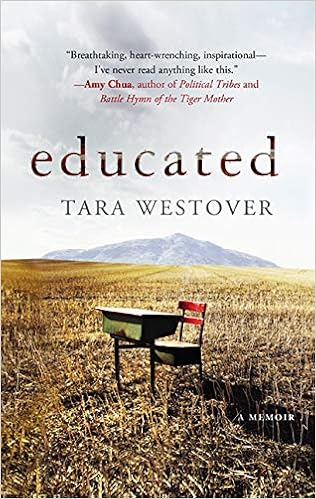
April 2018: Educated by Tara Westover

 Meeting Details: 
meeting at Tessa's house on either Thursday, April 4th at 7:30.  Discussion to begin at 8 pm.

Discussion Questions:

  1. Did you enjoy the book?  Why or why not?  How does it compare to other memoirs you've read?
  2. Tara Westover’s memoir recounts her life as the daughter of Mormon survivalist parents who leaves rural Idaho to pursue an education. What do you think she’s referring to with the title Educated? And what statement do you think the book makes on education at large?
  3. Westover’s quest for an education is a dramatic rebellion by her father’s standards. How does her rebellion differ from that of her older brother Tyler, if at all?
  4. Do you think being the youngest child in the family impacted Westover ultimately leaving her family? Would it have made a difference if she’d been the oldest child?
  5. Why is it significant that Westover didn’t know the word “holocaust” and had no knowledge of race issues in the United States?
  6. Which family member had the biggest influence on Westover’s quest for a different life? Which non-family members were influential on her life?
  7. Westover’s life changes dramatically thanks to an encouraging professor at Brigham Young University. How might her life be different if she hadn’t applied for the study abroad program at Cambridge University?
  8. Westover eventually finds her voice and realizes it’s just as powerful as the people who have influenced her life. What is voice, and how important is it that every child be encouraged to find their own?
  9. What impact does Westover’s pursuit of formal education have on her parents and family?
  10. How does education change Westover’s view of her childhood? How does she come to terms with how she was raised once she knows the value of education?
  11. Westover makes great efforts to ensure the story is as objective as possible, including footnotes where accounts of an event differ, or comparing her diary entries to her memory. As a reader, how important is objectivity in this story, and more largely, in memoirs in general?
  12. At 30, Westover is still relatively close in age to the events that occur in this book. How do you think the memoir would be different were it written when Tara was significantly older and more distanced from this time in her life? In what ways would it alter your interpretation of these experiences?
  13. Would you recommend this book?  To whom?  Why or why not?
(most questions from Bookbub.com)

Menu Ideas: Breakfast at the Westovers

One of Tara's opening images is the debate over family breakfast (pg 3-5) in which "breakfast became a test of loyalty," a theme that dominates the book.  Let's cook up a little breakfast goodness focusing on some of those hotly contested foods: butter, honey, dairy, corn flakes, cream of wheat (or even slippery canned peaches -an important survivalist food!)

Reminder: please weigh in on book choices for the upcoming months so that we can finalize that list!

Sunday, July 1, 2018

Celebrating Canada's 150th: July

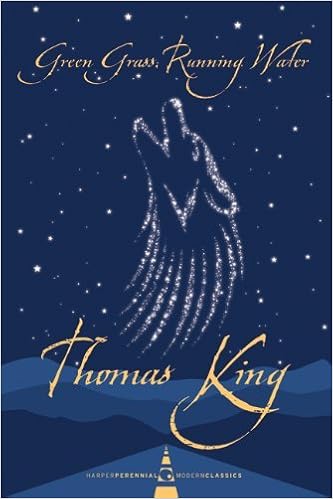
Sorry Ladies, it's Thomas King again this month... and until I read them all, I can't promise that this is the last time I talk about his books! 

Book Summary: Strong, Sassy women and hard-luck hardheaded men, all searching for the middle ground between Native American tradition and the modern world, perform an elaborate dance of approach and avoidance in this magical, rollicking tale by Cherokee author Thomas King. Alberta is a university professor who would like to trade her two boyfriends for a baby but no husband; Lionel is forty and still sells televisions for a patronizing boss; Eli and his log cabin stand in the way of a profitable dam project. These three—and others—are coming to the Blackfoot reservation for the Sun Dance and there they will encounter four Indian elders and their companion, the trickster Coyote—and nothing in the small town of Blossom will be the same again…  - from goodreads.com

My Thoughts: This book is so much more than the sum of its characters, really.  And its characters are great: Alberta, all full of well-educated, upper-class, urban middle age angst; Lionel, who is settling for a disappointing life and kidding himself that he'll change it all, go back to school, do something new, one day; Eli and his slow contemplation of life and his role in it.  And it's minor characters are great too!  But the real magic in this story is the story-telling done by the four narrators: The Lone Ranger; Robinson Crusoe, Hawkeye and Ishmael with their pesky companion, Coyote.   These are the bits that tie the whole novel together as well as add humor and depth of meaning.  I found these interludes clever, witty and insightful - Thomas King shows us that not only can he have a laugh at himself, but he invites us to join him as we have a laugh at Western civilizations, past and present, too.  And it's awfully hard not to join in!

Certainly not a must-read, but a fun and thoughtful book for fans of Thomas King!

Friday, June 1, 2018

Celebrating Canada's 150th: June

Who is Nicola Campbell?  "Named after her home, British Columbia's Nicola Valley, children's book author Nicola Campbell is Interior Salish on her mother's side and Métis from Saskatchewan on her father's side. Nicola currently lives in North Vancouver, B.C. with her son. She is completing a Master of Fine Arts in Creative Writing at the University of British Columbia.

Nicola writes adult and children's short fiction, poetry and has several works in progress including another free-verse picture book. She loves the outdoors; biking and hiking and has been participating in traditional cedar dug-out canoe racing for eleven years. She has a strong respect and an absolute belief in First Nation's spirituality, culture and tradition."

In the author's own words:
"I heard an elder speak of the importance of our languages and our culture. He said that our words are powerful; our stories are elastic; our languages are music: they dance, they move and they are medicine for our people. He said they are a spirit within themselves and we are only the channel that brings them to life. I write because I know what he said is true.  Shi-shi-etko and Shin-chi's Canoe are inspired by stories that I heard from my family, elders and community. As a child, I didn't understand why my mom, aunties and uncles and the elders in our community were taken away. I didn't understand why as children, they weren't allowed to speak — Indian. I knew that because of what my grandparents went through, they did not teach my mom or aunts and uncles to speak Nlekepmxcin and this was a common decision among many parents at that time. As children, my cousins and I could not fathom why all First Nations children everywhere were taken from their parents and forced to attend these schools. These two books are my efforts to illustrate these two children finding strength and resilience within themselves along with finding as many adventures as they could find." - from www.strongnations.com

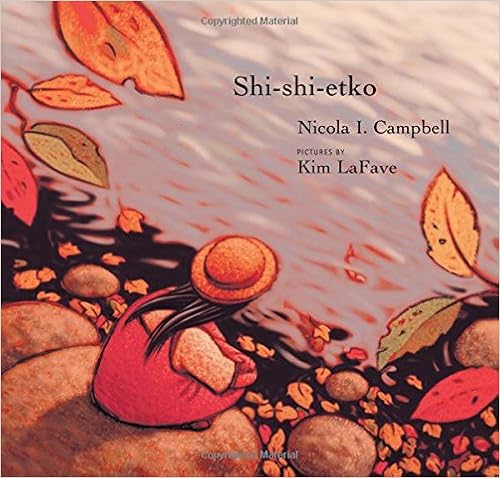
  Book Summary: In just four days young Shi-shi-etko will have to leave her family and all that she knows to attend residential school.
She spends her last days at home treasuring the beauty of her world -- the dancing sunlight, the tall grass, each shiny rock, the tadpoles in the creek, her grandfather's paddle song. Her mother, father and grandmother, each in turn, share valuable teachings that they want her to remember. And so Shi-shi-etko carefully gathers her memories for safekeeping.  Richly hued illustrations complement this gently moving and poetic account of a child who finds solace all around her, even though she is on the verge of great loss -- a loss that native people have endured for generations because of the residential schools system. - from amazon.ca

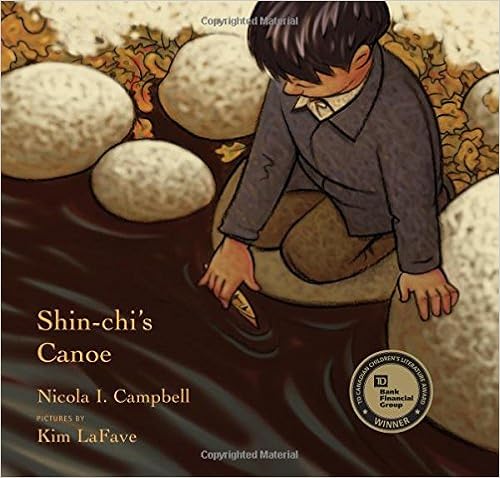
Book Summary: When they arrive at school, Shi-shi-etko reminds Shinchi, her six-year-old brother, that they can only use their English names and that they can't speak to each other. For Shinchi, life becomes an endless cycle of church mass, school, and work, punctuated by skimpy meals. He finds solace at the river, clutching a tiny cedar canoe, a gift from his father, and dreaming of the day when the salmon return to the river — a sign that it’s almost time to return home. This poignant story about a devastating chapter in First Nations history is told at a child’s level of understanding. - from amazon.ca


My Thoughts: I loved these two beautiful, gently told children's books. I would happily sit and read these with my 7 year old, but can just as easily see using these to introduce the topic of Residential Schools with a middle grade or junior high class.  What I like about these books is that they focus on the children's strength, resilience, strong family bonds, strong communities and the value of their culture and beliefs.  As much as we need stories that show the horrors, brutality and injustice of Residential schools, we also need to be reminded that these children weren't just subject TO something spirit-crushing, but that they were also removed FROM something nurturing and spiritual.

That said, we don't have to agree with their spiritual teachings and we don't have to condemn the religious beliefs of those who ran the schools - but we need to recognize that these children had homes, families and communities... the damage done extends far beyond the occasional abused child or an isolated case of a runaway here and there.

These are beautiful books that can be an important part of teaching our children about "our home on Native land". 

Wednesday, May 16, 2018

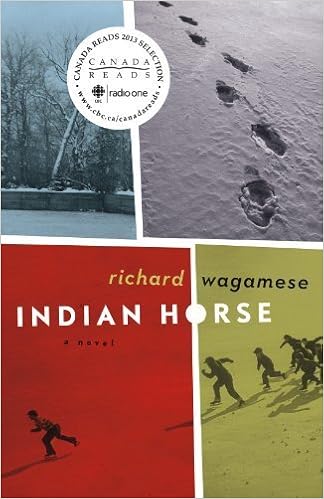
June 2018: Indian Horse by Richard Wagamese

Meeting Details: We'll be meeting on 
Thursday, June 28th at Tessa's house.

Discussion Questions:

1) Did you enjoy the book?  Why or why not?

2) The story is told as a first person narrative. How do you react to Saul? Do your attitudes to him change during the novel, and if so, what brings about these changes?

3) To which character(s) in the novel, other than Saul, do you react most strongly? Reflect on your reactions and the possible reasons for them

4) The novel vividly describes the effects on Saul when he is sent to a residential school: “I read once that there are holes in the universe that swallow all light, all bodies. St. Jerome’s took all the light from my world”(43)   How did reading the novel change your understanding of the residential school system and its lasting effects?

5) “One who loves does not brandish fear or require it” (26) What insights into Aboriginal spirituality do you gain from the novel? “Where is God now, then?” I asked (92)  Where do you find God in this story?

6) Richard Wagamese writes poetically about hockey, describing it as the “snow white stage”. What does hockey mean to Saul? Are all his hockey experiences positive? 

7) Racism is a very grim reality for Saul.  Give a few examples of racism in the book - how does Saul react to this racism?  While it is tempting to believe that these attitudes are no longer prevalent, examples can be found in many places. Reflect on examples of stereotyping or racism that you have experienced directly, have heard about from friends, or have witnessed in the media or other sources.

8) Richard Wagamese is an accomplished storyteller who has performed across the country. Was there one example of excellent story-telling in the book that you found particularly effective?

9) In reading Indian Horse, what did you learn about Indigenous peoples in Canada that you did not know before? 

10) “They scooped out our insides, Saul. We are not responsible for that. We are not responsible for what happened to us. None of us are,” Fred said. “But our healing – that’s up to us.” (210) What you do think "reconciliation" means?  How can we as individuals, Christians and as Canadians, be part of the healing?

11) What role does redemption play in Indian Horse?   The book begins with the idea of storytelling: “They say I can’t understand where I’m going if I don’t understand where I’ve been . . .”(2)   How does story-telling play a role in redemption?

12) Richard Wagamese has said that Indian Horse “…was a story clamoring to be told in a way that was empowering – that was not preachy, threatening or guilt inducing.” Do you feel Indian Horse is, in fact, a story told in a way that is empowering and not preachy, threatening or guilt inducing? Why or why not?

13) Would would recommend this book?  To whom and why or why not?

Many of the questions taken from www.amnestybookclub.ca 
(which also has some good background info about the book, if you're interested) and http://manitouconference.ca/img/Gillian-Indian-Horse.pdf 


Menu: Ma's First Rule is Food.

Martha Kelly believes in feeding growing boys well... the food's not fancy, but it's simple stick-to-your ribs fare made with what's locally available.  Her husband says about her: "Ma's first rule is food.  She cooks up a storm too."  And every serious hockey player knows that a meal should have as many parts as a hockey game!

For a smaller crowd, we may want to consider skipping the second period and going straight from First Period appetizers to Third Period desserts!

First Period:
Potato, Leek and Bacon Soup
Bannock

Second Period:
Fried fish
Fried onions and potatoes
Baked beans (canned is fine!)
Fresh bread
Pickles

Third Period:
Blueberry Cobbler
Ice Cream

Overtime: 
Chocolate Brownies
Coffee/tea

Reminder: Please take a few minutes to check out our book choices for Sept-December (posted below) so that we can choose books at the June meeting. 

Tuesday, May 1, 2018

Celebrating Canada's 150th: May


Son of a Trickster (The Trickster trilogy) by [Robinson, Eden]
I enjoyed Eden Robinson's Monkey Beach, so I was looking forward to this book too.

Book Summary: Shortlisted for the Scotiabank Giller Prize: With striking originality and precision, Eden Robinson, the author of the classic Monkey Beach and winner of the Writers’ Trust of Canada Fellowship, blends humor with heartbreak in this compelling coming-of-age novel. Everyday teen existence meets indigenous beliefs, crazy family dynamics, and cannibalistic river otters . . . The exciting first novel in her trickster trilogy.  Everyone knows a guy like Jared: the burnout kid in high school who sells weed cookies and has a scary mom who's often wasted and wielding some kind of weapon. Jared does smoke and drink too much, and he does make the best cookies in town, and his mom is a mess, but he's also a kid who has an immense capacity for compassion and an impulse to watch over people more than twice his age, and he can't rely on anyone for consistent love and support, except for his flatulent pit bull, Baby Killer (he calls her Baby)--and now she's dead.  Jared can't count on his mom to stay sober and stick around to take care of him. He can't rely on his dad to pay the bills and support his new wife and step-daughter. Jared is only sixteen but feels like he is the one who must stabilize his family's life, even look out for his elderly neighbours. But he struggles to keep everything afloat...and sometimes he blacks out. And he puzzles over why his maternal grandmother has never liked him, why she says he's the son of a trickster, that he isn't human. Mind you, ravens speak to him--even when he's not stoned.   You think you know Jared, but you don't.

My Thoughts:   I enjoyed Monkey Beach, but I LOVED Son of a Trickster!  You can tell that Eden Robinson has really upper her game and her writing is not just lush and cinematic, like it was in Monkey Beach, but her pacing and plot is much tighter and this results in a quickly paced, gripping novel of heart-break, love and loss.  Her main character, 16 yr old Jared, is the kind of cliche that everyone loves to rail against: scraping by academically,  smoking and drinking too much, dealing drugs, socially marginalized, living from hand to mouth and surrounded by an incredibly dysfunctional family.  It's so easy to blame a kid like that - and his family/community for producing him, but Robinson lets us in the backdoor to view his life from the inside and we see a teenager of incredible resilience, strength and compassion.  We see a kid who defies expectation at every turn and eventually finds courage and wisdom IN his culture, rather than despite it.  As Eden Robinson describes it: You think you know Jared, but you don't.

Equally compelling is Jared's new friend, Sarah, who is herself broken and hurting.  Sarah is a complex character who is alternately gentle and brutal; she pushed people away and then tenderly holds them close.  Jared is both drawn to her and repelled by her as well - and as he gets to know her, and he lets her into his own life, its mesmerizing to watch these two hurting kids find strength and courage in each other.

An excellently written novel that will take you on a roller coaster ride of emotions and leave you eager for the next installment of this planned trilogy.  I'll be first in line for the next book!

Monday, April 2, 2018

Celebrating Canada's 150th: April

Book Summary: 
Winner of the 2014 Governor General’s Literary Award for Fiction!  This is Thomas King’s first literary novel in 15 years and follows on the success of the award-winning and bestselling The Inconvenient Indian and his beloved Green Grass, Running Water and Truth and Bright Water, both of which continue to be taught in Canadian schools and universities. Green Grass, Running Water is widely considered a contemporary Canadian classic.

In The Back of the Turtle, Gabriel returns to Smoke River, the reserve where his mother grew up and to which she returned with Gabriel’s sister. The reserve is deserted after an environmental disaster killed the population, including Gabriel’s family, and the wildlife. Gabriel, a brilliant scientist working for Domidion, created GreenSweep, and indirectly led to the crisis. Now he has come to see the damage and to kill himself in the sea. But as he prepares to let the water take him, he sees a young girl in the waves. Plunging in, he saves her, and soon is saving others. Who are these people with their long black hair and almond eyes who have fallen from the sky?

Filled with brilliant characters, trademark wit, wordplay and a thorough knowledge of native myth and story-telling, this novel is a masterpiece by one of our most important writers.

My Thoughts: I was instantly hooked by this novel and by the time I finished it, I couldn't wait to begin it again.  Thomas King has a real talent for character - and an amazing capacity for compassion and humor.  Gabriel thinks himself the villain in this tale of environmental destruction and is determined to drown himself in the sea, and yet King writes him as an anguished, reluctant hero and you can't help but the feel compassion for him and urge him to fight for life.   Dorian Asher is more likely the villain in this disaster, as he's the powerful, profit hungry CEO of Domidion, but he doesn't see himself this way at all - as as King writes him as a man driven by his appetites and desires, crippled by health concerns and gob-smacked by his wife's affair and desire for a divorce - and I can't help but to feel a deep compassion for this shallow, misguided man and his rich, but empty life.  

Mara, Crispin and Sonny are truly some of the victims of this environmental crisis, but they refuse to see themselves this way, and readers won't see this either.  They're survivors, hope-rs, dreamers and eventually, doers, as the ocean, the reserve and the village begin to live, grow and thrive again.

A powerful book  that shows us meaningful reconciliation in action - full of intriguing characters, environmental caution, cultural hopefulness and genuine compassion, all told with Thomas King's deft comedic touch.  An absolute winner!

Thursday, March 1, 2018

Celebrating Canada's 150th: March

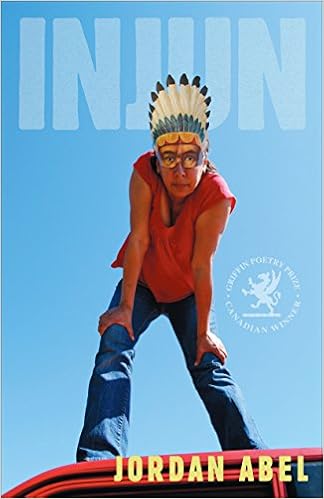
This month's read focuses heavily on the reality of racism, both historically, and today: Injun by Jordan Abel.

Book Summary: Award-winning Nisga'a poet Jordan Abel's third collection, Injun, is a long poem about racism and the representation of indigenous peoples. Composed of text found in western novels published between 1840 and 1950 - the heyday of pulp publishing and a period of unfettered colonialism in North America -Injun then uses erasure, pastiche, and a focused poetics to create a visually striking response to the western genre.

After compiling the online text of 91 of these now public-domain novels into one gargantuan document, Abel used his word processor's Find" function to search for the word "injun." The 509 results were used as a study in context: How was this word deployed? What surrounded it? What was left over once that word was removed? Abel then cut up the sentences into clusters of three to five words and rearranged them into the long poem that is Injun. The book contains the poem as well as peripheral material that will help the reader to replicate, intuitively, some of the conceptual processes that went into composing the poem.

Though it has been phased out of use in our "post-racial" society, the word "injun" is peppered throughout pulp western novels. Injun retraces, defaces, and effaces the use of this word as a colonial and racial marker. While the subject matter of the source text is clearly problematic, the textual explorations in Injun help to destabilize the colonial image of the "Indian" in the source novels, the western genre as a whole, and the Western canon."

My Thoughts: I wouldn't really describe this book as a "fun" read, and I wouldn't recommend that you read it in a sitting.  Instead, this collection needs to be read in the context of Jordan Abel's exploration of language, and in bite-sized portions.  I got this book last October, and I've been dipping in and reading bits once a week or so since then.  Every time I visit this collection, I notice something new or I'm disturbed by something that I didn't see before.   Here's how the main poem "Injun" begins:
a)
he played injun in gods country
where boys proved themselves clean
dumb beasts who could cut fire
out of the whitest1 sand
he played english across the trail
where girls turned plum wild
garlic and strained words
through the window of night
he spoke through numb lips and
breathed frontier2

In the second half of the collection, subtitled "Notes" Jordan Abel explores some of the other words that show up frequently in western novels.  He cuts out the line containing that word and lines up the sentences on the page so that the key word stands out.  When you read through the sentences, you get a strong sense of how that word is used, and what kind of meaning it holds.  In the case of the following example, you could easily replace the word "whitest" with "best" in the same way the word "injun" is often coupled with "dirty"

The neatest thing about reading this collection is imagining the writing of it - realizing that Abel is not writing in his own words, but that he's cutting apart novels and piecing them together in bits of his own... he literally deconstructs literature and recreates his own art from the ruins.  And what emerges is no longer the stereotyped "dead Injun" of western novels, but an alive, vibrant and rebellious nation of people who won't be defeated.

Although not really aimed at the average reader, I would recommend this challenging, "cutting" edge collection for those who don't mind some poetry that comes in impressions and big pictures, as opposed to poetry that can be analysed word by word.    I didn't understand this whole work, but that's ok - every time I go back to it, I'm challenged anew.

Thursday, February 1, 2018

Celebrating Canada's 150th: February

This month I've got another nonfiction title: Seven Fallen Feathers: Racism, Death and Hard Truths in a Northern City by Tanya Talaga

Book Summary: In 1966, twelve-year-old Chanie Wenjack froze to death on the railway tracks after running away from residential school. An inquest was called and four recommendations were made to prevent another tragedy. None of those recommendations were applied.


More than a quarter of a century later, from 2000 to 2011, seven Indigenous high school students died in Thunder Bay, Ontario. The seven were hundreds of miles away from their families, forced to leave home and live in a foreign and unwelcoming city. Five were found dead in the rivers surrounding Lake Superior, below a sacred Indigenous site. Jordan Wabasse, a gentle boy and star hockey player, disappeared into the minus twenty degrees Celsius night. The body of celebrated artist Norval Morrisseau’s grandson, Kyle, was pulled from a river, as was Curran Strang’s. Robyn Harper died in her boarding-house hallway and Paul Panacheese inexplicably collapsed on his kitchen floor. Reggie Bushie’s death finally prompted an inquest, seven years after the discovery of Jethro Anderson, the first boy whose body was found in the water.
Using a sweeping narrative focusing on the lives of the students, award-winning investigative journalist Tanya Talaga delves into the history of this small northern city that has come to manifest Canada’s long struggle with human rights violations against Indigenous communities. - from amazon.ca
My thoughts: This books was a gut-wrenching, heart-breaking reality check showing how racism is still very much alive and thriving in Canada today.   Tanya Talaga is a journalist with roots in Northern Ontario and working in Toronto.  She travels to Thunder Bay with a story in mind - wondering how to mobilize local First Nations so that they participate in federal elections - and discovers that her interview attempts fall flat on an audience who simply want to talk about the local high school students who've drowned in the river.  Local First Nations leaders are trying to raise alarm bells, and no one's listening.  Initially, Talaga is skeptical too.  But she promises to listen, do her research and if there's a story here, she promises to tell it. 

What she shares are the lives of 7 young people who died in mysterious, unexplained and poorly investigated ways.  She shares the stories of their families, who have to live with heartbreak and unanswered questions.  She shared the pain of northern communities who have been hurt, ignored, side-lined and forgotten - not just once or twice, but for generations.  

I would consider this book a must-read for all Canadians.  Genuine reconciliation requires knowledge and compassion, and then action. Several times, this book points out in very clear ways the role of an uncaring public: if we're not interested and don't care, then racists can get away with racist attitudes, remarks and actions; then police services can get away with hasty, inconclusive answers; then politicians can get away with big talk and small action. 

All of these young people were living far away from their communities, family and friends - essentially, they were orphans.  And rather than caring for the vulnerable: the young, the orphans and the poor, the city of Thunder Bay, Ontarians and Canadians turned a blind eye to their suffering and the deaths and preferred easy answers over hard truths.  Now, Tanya Talaga is calling on us all to really see these young people and their families.  To look and not turn away.  And the truth is a painful one that requires action.

Monday, January 1, 2018

Celebrating Canada's 150th: January

Nothing like starting off a new year right!  This month's book is the intriguing and memorable, Monkey Beach by Eden Robinson.

Book Summary:  Monkey Beach combines both joy and tragedy in a harrowing yet restrained story of grief and survival, and of a family on the edge of heartbreak. In the first English-language novel to be published by a Haisla writer, Eden Robinson offers a rich celebration of life in the Native settlement of Kitamaat, on the coast of British Columbia. - from amazon.ca

My Thoughts:  I really enjoyed the colorful cast of characters in this engaging novel - Lisamarie and her wisecracks, her grandmother and her insight, her uncle and his activism, her father and his devotion, her brother and his single mindedness.  This novel created a vivid sense of place... and this damp west-coast fishing village is a character in its own right.

The plot line is almost an afterthought and mystery lovers who are captured by the question of what happened to Lisamarie's brother in the fishing boat (the impetus for the whole story, as Lisa spends the remainder of the book travelling alone to the site of the accident and reminiscing about their lives) will likely be disappointed by the lack of an exciting conclusion and the fairly abrupt ending to the story.

If you love a wet, west-coast setting, memorable characters as they come of age, and a realistic look at how native spirituality affects people's lives today, then you'll likely find this book well worth your time, as I did.  I loved the glimpses into the lasting effect that the residential school tragedy has in communities like Lisamarie's... this isn't the focus of the book at all, but this pain has very real implications for Lisa's generation as well, and I think that stories like hers are a very powerful witness to the ongoing trauma caused by abuse/neglect in residential schools. 

A memorable first novel by an original Canadian voice - I look forward to reading her 2nd book, Son of a Trickster, too.

Friday, December 1, 2017

Celebrating Canada's 150th: December

Medicine Walk by [Wagamese, Richard]Next up, Richard Wagamese' Medicine Walk.

Book Summary:
By the celebrated author of Canada Reads Finalist Indian Horse, a stunning new novel that has all the timeless qualities of a classic, as it tells the universal story of a father/son struggle in a fresh, utterly memorable way, set in dramatic landscape of the BC Interior. For male and female readers equally, for readers of Joseph Boyden, Cormac McCarthy, Thomas King, Russell Banks and general literary.      Franklin Starlight is called to visit his father, Eldon. He's sixteen years old and has had the most fleeting of relationships with the man. The rare moments they've shared haunt and trouble Frank, but he answers the call, a son's duty to a father. He finds Eldon decimated after years of drinking, dying of liver failure in a small town flophouse. Eldon asks his son to take him into the mountains, so he may be buried in the traditional Ojibway manner. What ensues is a journey through the rugged and beautiful backcountry, and a journey into the past, as the two men push forward to Eldon's end. From a poverty-stricken childhood, to the Korean War, and later the derelict houses of mill towns, Eldon relates both the desolate moments of his life and a time of redemption and love and in doing so offers Frank a history he has never known, the father he has never had, and a connection to himself he never expected.   A novel about love, friendship, courage, and the idea that the land has within it powers of healing, Medicine Walk reveals the ultimate goodness of its characters and offers a deeply moving and redemptive conclusion. Wagamese's writing soars and his insight and compassion are matched by his gift of communicating these to the reader.

My Thoughts: I was absolutely gutted by this book; weeks after finishing this one, I can hardly handle the book without feeling choked up all over again.  The writing is absolutely top notch: spare, poetic, and deeply, unflinchingly honest.  I loved this book from cover to cover and I'm already looking forward to a second read.

Franklin Starlight is a simple, hardworking 16 year old boy who's got a lot of questions about his past that never seem to get answered.  Just when he begins to decide that he can live without answers, his father calls upon him for one heroic quest before he dies.  Initially, it's awfully hard to dredge up the slightest bit of sympathy for Eldon, but as his story unfolds and intertwines with Franklin's, the reader follows Franklin on this journey of understanding, compassion and healing. 

I'm not sure why this book hit me so hard... maybe it helps that I have a 17 yr old son that I tried to imagine in Franklin's shoes?  Powerfully and movingly told, this book cause my world to tilt a little on it's axis, and I'm not sure I'm ever going to be the same person I was before.  And isn't that, ultimately, the greatest compliment that you could ever pay an author?

Highly recommended; Indian Horse just got bumped way up on my reading list, too. 

Wednesday, November 1, 2017

Celebrating Canada's 150th: November

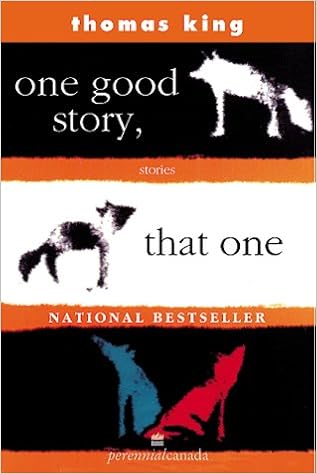
It's Thomas King this month again, but this time, a short story collection: One Good Story, That One.

Book Summary:There is much more than one good story in this bestselling (over 10,000 copies sold) collection of short fiction. In fact, there are more than a few of the best examples of native storytelling ever published. Thomas King, author of the acclaimed Medicine River and Green Grass, Running Water, and the newly released Truth and Bright Water, has proven he has a magical gift, a fresh voice and a special brand of wit and comic imagination. 

One Good Story, That One is steeped in native oral tradition, led off by a sly creation tale, introducing the traditional native trickster coyote. Weaving the realities of native history and contemporary life through the story, King recounts a parody version of the Garden of Eden story, slyly pulling our leg and our funny bone.

A collection that is rich with strong characters, alive with crisp dialogue and shot through with the universal truths we are all
searching for, One Good Story, That One is one great read.- from amazon.ca

My Thoughts: Oh, Thomas King is a clever one and he knows just how to get his readers to challenge our view of the world and our assumptions about Indigenous people by pushing us past our comfort zones and then having a laugh at himself.  I have a hard time picking a favorite story, but here are two noteworthy ones.

Joe Painter and the Deer Island Massacre - Joe recruits the only "Indian" he knows, a friend he nicknames "Chief" to help tell the story of their town's founding for an anniversary celebration.  A group of friends and family rally and help act out Joe's play - acting the parts of both the "Indians" and the "good Christian citizens" in a play that depicts the massacre that precedes the building of the town.  Ironically, the "Indians" don't look "Indian-enough" and Joe finds black wigs and yarn braids to increase their authenticity.  Meanwhile, the "chief's" family and friends have a hoot performing in the play and laughing at how completely clueless Joe is about the ridiculousness of the play they're performing.  A wonderful illustration of racism in action today and the strength and humor of Indigenous people.

Borders - a son tells the story of him and his mother trying to cross the border to visit his older sister in Salt Lake City.  At both border crossings, his mother declares her citizenship as "Blackfoot" and gets stuck in limbo while the border guards figure out what to do with her!
A powerful story about nationhood, sovereignty and citizenship.

If you enjoy short stories, this is a intelligent and witty collection that is sure to having you seeing Native people in a fresh new light. Not a difficult read, but you'll want to take it one story at a time to allow you time to think about each one.  Highly recommended.

Monday, October 2, 2017

Celebrating Canada's 150th: October

Birdie by [Lindberg, Tracey]This month's book: Birdie by Tracey Lindberg.  I actually read this one in August while on holidays and I wouldn't recommend this as a beach read as it's pretty deep and quite sad.


Book Summary:  Monkey Beach meets Green Grass, Running Water meets The Beachcombers in this wise and funny novel by a debut Cree author.  Birdie is a darkly comic and moving first novel about the universal experience of recovering from wounds of the past, informed by the lore and knowledge of Cree traditions. Bernice Meetoos, a Cree woman, leaves her home in Northern Alberta following tragedy and travels to Gibsons, BC. She is on something of a vision quest, seeking to understand the messages from The Frugal Gourmet (one of the only television shows available on CBC North) that come to her in her dreams. She is also driven by the leftover teen aged desire to meet Pat Johns, who played Jesse on The Beachcombers, because he is, as she says, a working, healthy Indian man. Bernice heads for Molly’s Reach to find answers but they are not the ones she expected. With the arrival in Gibsons of her Auntie Val and her cousin Skinny Freda, Bernice finds the strength to face the past and draw the lessons from her dreams that she was never fully taught in life. Part road trip, dream quest and travelogue, the novel touches on the universality of women's experience, regardless of culture or race. - from amazon.ca

My thoughts: I loved this book, but reader beware that the majority of the book is dark, gritty and moving and although there are hints of hopefulness and healing throughout the book, the book doesn't really have a Sherrie-approved happy ending.  

I loved the strong, amazing - and hurting - women in this book and I would love to sit in the bakery and have a tea and a chat with them all.  Lindberg does a great job of creating realistic, well rounded characters and she refrains from over-explaining them or providing too much of their backstory so that the reader is left curious and wanted a book about each one of them!  I loved how the majority of the story is told by a woman who spends weeks lying on her bed, motionless.  This book is really not about what happens to her or around her, but is truly about Birdie's interior story... how she processes all her experiences and finds wholeness and healing.  I loved how Cree vocabulary, traditions, story-telling and dream scapes are woven into the story to provide a rich scaffolding of culture in which to understand Birdie's life.

Lindberg manipulates language so cleverly to convey the complicated, contradictory truth of life, using invented compound words like screamwheeze, cousinemotion, and im/patience.   She has a powerfully poetic way of using words and punctuation, like here:  "Bernice had forgotten about that when she would allow herself to ragemember.  And she could also not forget Freda's shaky lip when the door was kicked closed in front of her.  The knowing in her eyes.  She knew.  At the very least, Freda had noticed.  And. Was relived. That. It was not. Her." (pg 155).    

A difficult read, but well worth the effort!


Friday, September 1, 2017

Celebrating Canada's 150th: September


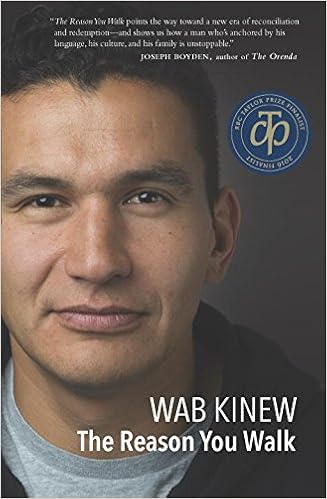
I've watched his 8th Fire series on CBC, so I was excited to read this memoir next on my list. 

Book summary: When his father was given a diagnosis of terminal cancer, Winnipeg broadcaster and musician Wab Kinew decided to spend a year reconnecting with the accomplished but distant aboriginal man who'd raised him. The Reason You Walk spans the year 2012, chronicling painful moments in the past and celebrating renewed hopes and dreams for the future. As Kinew revisits his own childhood in Winnipeg and on a reserve in Northern Ontario, he learns more about his father's traumatic childhood at residential school. An intriguing doubleness marks The Reason You Walk, a reference to an Anishinaabe ceremonial song. Born to an Anishinaabe father and a non-native mother, he has a foot in both cultures. He is a Sundancer, an academic, a former rapper, a hereditary chief, and an urban activist. His father, Tobasonakwut, was both a beloved traditional chief and a respected elected leader who engaged directly with Ottawa. Internally divided, his father embraced both traditional native religion and Catholicism, the religion that was inculcated into him at the residential school where he was physically and sexually abused. In a grand gesture of reconciliation, Kinew's father invited the Roman Catholic bishop of Winnipeg to a Sundance ceremony in which he adopted him as his brother. Kinew writes affectingly of his own struggles in his twenties to find the right path, eventually giving up a self-destructive lifestyle to passionately pursue music and martial arts. From his unique vantage point, he offers an inside view of what it means to be an educated aboriginal living in a country that is just beginning to wake up to its aboriginal history and living presence. 
     Invoking hope, healing and forgiveness, The Reason You Walk is a poignant story of a towering but damaged father and his son as they embark on a journey to repair their family bond. By turns lighthearted and solemn, Kinew gives us an inspiring vision for family and cross-cultural reconciliation, and a wider conversation about the future of aboriginal peoples.- from amazon.ca

My thoughts: Wab openly acknowledges that he and his people are proud and stoic - which makes this open, honest and emotionally intense memoir all the more compelling.  You can hear, at times, in his story-telling that he's reluctant to reveal difficult situations or deep feelings - and sometimes, he pulls back from the reader - but many times, he bravely tells his story, and the story of his father and his sons, as it needs to be told.


I learned so much about Indigenous culture, spirituality, and families; I saw in a very real way how the horrors of residential schools affected the survivors, but also their families - their children and grandchildren.  And I was humbled and amazed to hear how Wab's father worked relentlessly to make peace, reconciliation and forgiveness a very real aspect of his everyday life.  


An important, positive, hopeful and emotional look at how Indigenous people and other Canadians can learn from each other, understand each other and put true reconciliation into action. 


Tuesday, August 1, 2017

Celebrating Canada's 150th: August

August's title is Truth and Bright Water by Thomas King.  I enjoyed his nonfiction book so much that I thought I'd try a novel too.  And he didn't disappoint!

Image result for truth and bright water  Book Summary: Truth & Bright Water is the tale of two young cousins and one long summer. Tecumseh and Lum live in Truth, a small American town, and Bright Water, the reserve across the border and over the river. Family is the only reason most of the people stay in the towns, and yet old secrets and new mysteries keep pulling the more nomadic residents back to the fold.

Monroe Swimmer, famous Indian artist, returns to live in the old church with the hope of painting it into the prairie landscape and re-establishing the buffalo population. Tecumseh’s Aunt Cassie has come back too, already arguing with his mother. Why has his mother given Cassie a suitcase full of baby clothes? And why is Lum interested only in winning the Indian Days race?

Tecumseh has more questions than anyone will answer, until the Indian Days festival arrives and the mysteries of the summer collide in love, betrayal and reconciliation. Equally plainspoken and poetic, comic and poignant, Truth & Bright Water is a crackling good story that resonates with universal truths.


My Thoughts: I really enjoyed this book... King's sense of humor clearly shines through and at the same time, he doesn't hold back on the darkness either.  I found Monroe Swimmer a fascinating character... he's one of the few who seems to "escape" from Truth and Bright Water and find success out in the world, but he returns seeming so broken.  I love how he buys the mission church and paints it so that it disappears into the landscape and sets up sculptured buffalo in the fields around it...a very literal use of art to erase the damage done by missions among the Indigenous people and to try to restore the old order.  Swimmer restores the old practice giving away all your possessions at a pot latch and uses this to bring healing in the community.  He says he's moving on... he's heard there's a former residential school for sale and he's going to buy it and paint it away.  

And Lum; Oh, Lum... Lum will baffle you and break your heart, especially if you're the parent of a teen aged boy.  

This book has it all - mysteries, memorable characters, relationships, art, nature, culture, humor, darkness and overall, a glimmer of hope.  Definitely worth the read!

Saturday, July 8, 2017

Celebrating Canada's 150th: July

Inspired by our recent discussion of Wenjack by Joseph Boyden, I've decided to celebrate Canada's 150th anniversary in my own, strange, book-ish way: by reading an indigenous author every month for the year and I thought you all might get a kick out of following along.  I'm purchasing these books to build my collection, so feel free to borrow one if anything along the way tickles your fancy!

So, here's my July title:  
The Inconvenient Indian: A Curious Account of Native People in North America 
by Thomas King
Image result for the inconvenient indian
  Book SummaryRich with dark and light, pain and magic, The Inconvenient Indian distills the insights gleaned from Thomas King's critical and personal meditation on what it means to be "Indian" in North America, weaving the curiously circular tale of the relationship between non-Natives and Natives in the centuries since the two first encountered each other. In the process, King refashions old stories about historical events and figures, takes a sideways look at film and pop culture, relates his own complex experiences with activism, and articulates a deep and revolutionary understanding of the cumulative effects of ever-shifting laws and treaties on Native peoples and lands. 
     This is a book both timeless and timely, burnished with anger but tempered by wit, and ultimately a hard-won offering of hope--a sometimes inconvenient but nonetheless indispensable account for all of us, Indian and non-Indian alike, seeking to understand how we might tell a new story for the future. - from amazon.ca
My thoughts:  I really enjoyed this nonfiction title.  King has a great sense of humor and a keen eye for the bigger picture and I was surprised how often I found myself laughing out loud... and it was very refreshing to be able to laugh with the author in the midst of this difficult history.

I like how King dealt in a very straightforward way with many of the questions that people ask and comments that people make... like: why can't you just get over it?  And, you were conquered, move on!  And, quit your complaining and move off the reserve already!  And, why should you get all these freebies and handouts?

Using history, logic and personal experience, King exposes many of the misunderstandings of today and shows how racism is still very much alive in North America.

I like how he uses the phrase "Dead Indian" to describe the stereotypical movie image of a half-naked, child-like savage warrior who's brave but needs the guidance of a kindly white leader to succeed.  King shows how we've become attached to that romantic image of and how the very real, alive Indigenous people of today are a disappointment in that they don't fit that mold.  Society enjoys the old-time dress-up "Dead Indian" at a summer time Pow-wow, but doesn't know what to do with young, angry, white-collar Native people living and working in cities, for example.  We like the image of the fur-clad Inuit living in igloos and eating seal blubber (as long as no seals were harmed in the making of this movie!), but can't get our heads around a modern, northern hunting and trapping operation or the idea that Inuit people might want to work in industries other than hunting and trapping!

Overall, King does a terrific job of facing many of the modern issues facing Indigenous peoples by exposing the past and confronting the racism that is still alive today. An excellent tool for building context and a valuable overview for anyone with a deeper interest in the fate of Indigenous people in North American today.

Wednesday, June 14, 2017

July 2017: Turn Right at Machu Picchu by Mark Adams

Image result for turn right at machu picchu Meeting Details: We're getting together at Tessa's house on Thursday, July 6th at 7:30 pm, with discussion to begin at 8pm. 

- cancelled; possible rescheduling at Chandra's next week

Discussion Questions:


1. Did you enjoy the book?  Why or why  not?
2. Discuss the guide, John Leivers, and his role and how he impacts the author’s trip.
3. Discuss the similarities and differences between Bingham I, II and III.
4. On page 52, John says to Mark regarding hiking and that it will get easier as his body adapts, “ There’s a general law in life. The body and mind only get stronger when they’re traumatized.” Do you agree with this law of John’s? 
5. Discuss the author’s transition from desk editor to adventurer/explorer and how it changes his life.
6. Why does the Inca culture and civilization hold so much fascination for us today?
7. Why was the longer traditional second trip to Machu Picchu more meaningful that the author’s first trip there?
8. Discuss the role and interrelatedness of the different Inca sites and paths.
9. Discuss the Spanish encounters with the Inca civilization and how its effect are evident today.
10. Does this book inspire you to visit Peru? Machu Picchu? If so, why and if not, why?
11. Would you recommend this book to others?  To who and why?

Menu Ideas: "Holiday in Peru"... a cool nibbling menu for a hot summer day!  

- Peruvian Grilled Chicken Skewers - Karen
Causa (peruvian layered potato dish)
Peruvian Pickled Onions
Solterino Salad (quinoa salad) - Sherri
Stuffed Avocados 

Dessert:
- Fruit Espuma (raspberry jello dessert)
- Alfajores (dulce de leche cookies)
- Strawberry Cheescake -- Chandra 

Drinks: lemonade and mango juice - Tessa

(Note: questions and menu may be modified slightly when I finish reading the book!)